Commercial Painting vs Residential: Key Differences
Two Fundamentally Different Types of Projects
From the outside, painting is painting — rollers, brushes, gallons of paint, and a crew that shows up in white-splattered clothes. But commercial painting and residential painting are fundamentally different disciplines. The scale, the products, the scheduling, the safety requirements, and even the way projects are priced follow entirely different rules. Understanding these differences matters whether you're a property manager getting bids on an office building or a homeowner wondering why the same company charges so differently for your house versus your business.
This guide breaks down the real differences between commercial and residential painting — pricing, process, products, and what to look for when choosing a contractor for either type of work.
Scale and Scope: The Most Obvious Difference
The most immediate difference between commercial and residential painting is sheer scale. A typical Chicago residential interior — a 3-bedroom home or condo — involves 1,500 to 3,000 square feet of wall and ceiling space. A commercial interior — even a modest office suite or retail space — can easily run 5,000 to 20,000 square feet. Warehouse and industrial spaces can exceed 50,000 square feet of paintable surface.
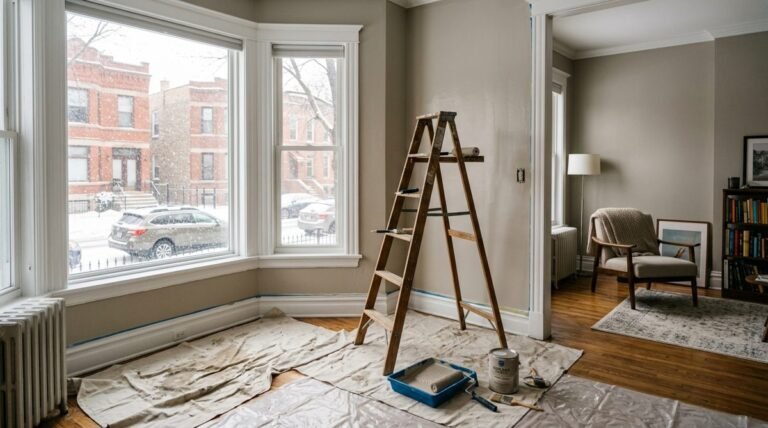
This difference in scale affects everything downstream: crew size, project duration, material quantities, equipment needs, and logistics planning. A residential interior typically requires a crew of 2 to 3 painters working for 3 to 5 days. A commercial interior of comparable quality might require 4 to 8 painters working for 1 to 3 weeks — often during off-hours to avoid disrupting the client's business operations.
Timelines are also structured differently. Residential projects are scheduled in days. Commercial projects are scheduled in phases — often coordinated with tenant move-ins, lease turnovers, or business reopening dates. Missing a commercial deadline can cost the property owner thousands in lost revenue, which creates a fundamentally different pressure dynamic than a homeowner waiting an extra day for their living room to be finished.
Pricing: How Commercial and Residential Rates Compare
Pricing structure differs significantly between the two sectors. Residential painting is typically quoted as a flat project price or a per-room price. Commercial painting is almost always quoted by the square foot, with separate line items for different surface types and coating systems.
| Project Type | Typical Price Range | Pricing Method |
|---|---|---|
| Residential interior | $2 – $4 per sq ft | Per room or flat project bid |
| Residential exterior | $3,500 – $8,000 per home | Flat project bid |
| Commercial interior | $1.50 – $3.50 per sq ft | Per square foot |
| Commercial exterior | $2 – $5 per sq ft | Per square foot |
You'll notice that the per-square-foot rate for commercial interiors is often lower than residential. This isn't because commercial work is cheaper or lower quality — it's because commercial spaces have more open, uninterrupted wall space. There are fewer windows to cut around, fewer switch plates to remove, fewer pieces of furniture to move, and fewer fussy trim details. The efficiency is higher, which brings the per-foot cost down even as the total project cost is significantly larger.
Volume matters: A 15,000-square-foot commercial interior at $2.50/sq ft is a $37,500 project — much larger in total than most residential jobs. Commercial painters operate on thinner margins per square foot but larger total revenue per project. This is why pricing structure, not just pricing level, is fundamentally different.
Products and Coatings: Commercial-Grade vs. Residential
The paint products used in commercial work are often entirely different from what goes on your living room walls. Residential painting typically uses premium interior latex — products like Sherwin-Williams Emerald, Benjamin Moore Regal Select, or similar lines designed for color accuracy, washability, and low odor in occupied living spaces.
Commercial projects frequently require specialized coating systems:
- High-durability latex paints: Commercial spaces see more traffic, more contact, and more abuse than residential spaces. Products like SW ProMar 700 or BM Ultra Spec 500 are formulated for scrubbability and stain resistance in high-traffic environments.
- Epoxy floor coatings: Warehouse floors, commercial kitchens, and industrial spaces often require two-part epoxy or urethane floor coatings that residential painters rarely work with. These products require specific surface preparation (shot blasting or acid etching) and precise mixing ratios.
- Anti-microbial and anti-graffiti coatings: Healthcare facilities, schools, and public-facing commercial spaces may require paints with anti-microbial additives. Properties in urban areas may specify anti-graffiti clear coats on exterior surfaces.
- Fire-retardant coatings: Chicago fire code requires fire-retardant coatings (intumescent paint) on certain structural steel members and in specific occupancy types. This is an entirely different product category from anything used in residential work.
- Industrial primers and coatings: Metal surfaces, concrete block, and CMU walls require specialized primers and coatings that bond to those substrates — standard drywall primer won't adhere to concrete block or bare steel.
Scheduling: Nights, Weekends, and Phased Work
One of the biggest operational differences between commercial and residential painting is when the work happens. Residential painting almost always takes place during standard business hours — the crew arrives at 8:00 AM and wraps up by 5:00 PM, Monday through Friday. The homeowner may be home or may be at work, but the scheduling is straightforward.
Commercial painting is a completely different scheduling challenge. Painting an occupied office suite, a restaurant, or a retail store during business hours is often impossible — the fumes, the disruption, the access restrictions, and the safety concerns make it impractical. As a result, commercial painting frequently happens:
- Nights: 6:00 PM to 6:00 AM shifts are common for office buildings and retail spaces
- Weekends: Friday evening through Sunday evening is a popular window for restaurants and retail
- Phased sections: Large commercial spaces are often painted in phases — one floor or one wing at a time — to keep the building operational during the project
- Tenant turnovers: The most efficient commercial painting happens between tenants, when the space is completely empty. Property managers schedule painting during the gap between move-out and move-in.
Scheduling flexibility is a major differentiator when choosing a commercial painting contractor. A company that can only work Monday through Friday, 8 to 5, is not equipped for most commercial work. Ask about night and weekend crew availability before you commit.
Safety, Compliance, and Regulations
Safety requirements escalate dramatically from residential to commercial work. A residential paint job might involve a 6-foot step ladder and basic drop cloths. A commercial project can involve:
- OSHA compliance: Commercial job sites must comply with OSHA regulations for fall protection, scaffolding, respiratory protection, and hazardous materials handling. This includes written safety plans, site-specific training, and proper documentation.
- Scaffolding and lifts: Multi-story commercial exteriors require scaffolding systems, boom lifts, or swing stages — equipment that most residential painters never touch. Operators must be trained and certified.
- Confined space protocols: Painting in mechanical rooms, utility tunnels, elevator shafts, or below-grade spaces requires confined space entry procedures, including air monitoring and rescue planning.
- VOC compliance: Chicago and Illinois have specific VOC (volatile organic compound) limits for architectural coatings. Commercial projects — especially in healthcare, education, and food service — may have additional low-VOC or zero-VOC requirements beyond standard code.
- Insurance requirements: Commercial building owners and property managers typically require contractors to carry significantly higher general liability limits ($1M to $5M or more), workers' compensation, and sometimes umbrella policies. A residential painter carrying $500K in general liability may not qualify for commercial work.
Surface Types: Drywall Is Just the Beginning
Residential painting is predominantly drywall work — smooth or textured gypsum board walls and ceilings, with wood trim and doors. The surface preparation and product selection are relatively consistent from room to room and house to house.
Commercial painting involves a much wider range of substrates, each requiring different preparation and product approaches:
- Concrete and CMU block: Common in commercial buildings, warehouses, and parking structures. Requires block filler primer and coatings formulated for masonry adhesion.
- Structural steel and metal: Exposed steel beams, metal door frames, metal decking, and handrails all require rust-inhibitive primers and DTM (direct-to-metal) coatings.
- Concrete floors: Require surface profiling (grinding or shot blasting), moisture testing, and specialized epoxy or urethane floor systems.
- Exterior stucco and EIFS: Commercial exteriors may use elastomeric coatings that bridge hairline cracks and provide waterproofing over stucco or EIFS systems.
- Previously coated commercial surfaces: Repainting commercial spaces often means dealing with multiple layers of different coating types applied over decades, requiring careful assessment of what's there before deciding what goes on next.
Types of Commercial Painting Projects
The range of commercial painting work is far broader than most people realize. Commercial painting encompasses:
- Office buildings and corporate spaces: Professional finish, neutral palettes, often coordinated with branding guidelines
- Restaurants and hospitality: Feature walls, bold colors, specialty finishes, tight weekend-only schedules
- Retail stores: Fast turnaround, brand-specific color standards, overnight work common
- Warehouses and industrial: High-durability coatings, floor systems, safety line striping, large volumes
- HOA common areas: Hallways, lobbies, stairwells, parking garages — recurring maintenance painting on annual or biannual cycles
- Healthcare facilities: Anti-microbial coatings, low-VOC products, infection control protocols during painting
- Educational facilities: Summer-only scheduling, low-VOC requirements, high-durability in high-traffic areas
- Multi-family residential: Unit turnovers, common area maintenance, coordinated with property management schedules
Warranty and Maintenance Programs
Residential paint jobs typically come with a one-time warranty — usually 1 to 3 years on labor and workmanship. If something peels or fails within the warranty period, the contractor comes back and fixes it. Beyond the warranty period, you call for a new quote.
Commercial painting often operates on a different model entirely. Many commercial clients — especially property management companies and HOAs — establish ongoing maintenance contracts with their painting contractor. These contracts might include:
- Annual touch-up and inspection visits
- Scheduled repainting cycles (every 3 to 5 years for high-traffic areas)
- Priority scheduling for emergency repairs (damage from tenants, water events, etc.)
- Locked-in pricing for recurring work
This relationship model benefits both parties: the property owner gets consistent quality and predictable costs, and the contractor gets steady, recurring revenue. It's a fundamentally different business relationship than the one-and-done nature of most residential work.
Chicago Commercial Considerations
Painting commercial properties in Chicago involves several city-specific factors that don't apply in most other markets:
- City permits: Exterior scaffolding on commercial buildings in Chicago may require a sidewalk closure permit, a construction permit, or both. The permitting process can add 2 to 4 weeks to project start dates and several hundred dollars in fees.
- Union considerations: Chicago has a strong union presence in the trades. Some commercial building owners, especially in the Loop, River North, and institutional settings, require or prefer union labor. Understanding the labor landscape is important when bidding commercial work in Chicago.
- Fire code compliance: Chicago's fire code has specific requirements for fire-retardant coatings in commercial buildings, particularly on exposed structural steel and in assembly occupancies. Your painting contractor needs to know these requirements and use compliant products.
- High-rise logistics: Chicago's skyline means commercial painting can involve significant height work. Swing stages, boom lifts, and rope access techniques are part of the commercial painting toolkit in this city in ways they aren't in lower-rise markets.
- Historic preservation: Many commercial buildings in Chicago's landmark districts have specific requirements for exterior coatings, colors, and application methods. Non-compliant work can result in fines and mandatory removal.
Why choose a company that does both? A painting company with genuine experience in both residential and commercial work brings a unique advantage: they understand the quality standards that homeowners demand and the operational discipline that commercial clients require. The attention to detail learned in residential work elevates commercial results, and the efficiency and systems thinking learned in commercial work benefits residential clients. At RenewBuild, we maintain the same quality standards regardless of project type.
Why RenewBuild for Both Residential and Commercial
RenewBuild Painting serves both residential homeowners and commercial property owners across Chicago and the surrounding suburbs. We built our reputation on residential work — meticulous prep, premium products, and finishes that last — and we bring that same standard to every commercial project we take on.
Our commercial capabilities include flexible night and weekend scheduling, crews trained for multi-story and height work, familiarity with commercial-grade coating systems including epoxy floors and DTM metal coatings, and the insurance coverage that commercial property managers require. Whether you need your Lincoln Park home refreshed or your River North office suite repainted between tenants, we approach every project with the same commitment to preparation, quality products, and clean execution.
We carry full general liability, workers' compensation, and EPA Lead-Safe certification (NAT-F308152-1). We're licensed, bonded, and insured for both residential and commercial work in the City of Chicago and surrounding municipalities.
Get Your Free Estimate
From a single room to a 50,000-square-foot commercial space, we'll visit your property, assess the scope, and deliver a detailed written quote. Same quality standards, every project.
Related Articles
Downtown, Chicago’s North Side & the North Shore
Based downtown and serving Chicago’s North Side and the North Shore suburbs, so every crew is close, on time, and familiar with the homes in your neighborhood.
Not sure if we cover your area? See all service areas or call (312) 561-4512.
RenewBuild Serves Chicago & North Shore
Looking for a painter near you? We serve homes and businesses on Chicago's North Side, Downtown and the North Shore.