Deck Staining vs. Painting: Which Is Right for Your Porch?
The Short Answer: For Most Chicago Porches, Stain Wins
If you own one of Chicago's classic wooden back porches or a wood deck, staining is almost always the better choice — it protects the wood without trapping moisture, wears gracefully, and is far easier to maintain over time. Paint has its place on some exterior wood, but on horizontal deck surfaces that take standing water and constant foot traffic, paint tends to trap moisture and peel.
That said, it's not a blanket rule. Here's the honest, side-by-side comparison so you can decide what's right for your specific porch.
Deck Stain vs. Deck Paint: Side by Side
| Factor | Stain | Paint |
|---|---|---|
| How it works | Penetrates into the wood and seals it | Forms a film that sits on top of the wood |
| Look | Shows wood grain (semi) or rich solid color | Fully opaque, hides the wood entirely |
| On deck floors & stairs | Excellent — breathes, resists peeling | Risky — traps moisture, peels under traffic |
| Maintenance | Clean & recoat — no stripping needed | Must scrape/strip peeling paint before recoat |
| Recoat cycle (Chicago) | Every 1–3 years | Every 3–5 years, but harder redo |
| Upfront cost | Lower to moderate | Similar upfront, higher long-term |
| Best for | Decks, back porches, fences, railings | Vertical trim, railings not walked on, columns |
The Core Difference: Penetrate vs. Sit on Top
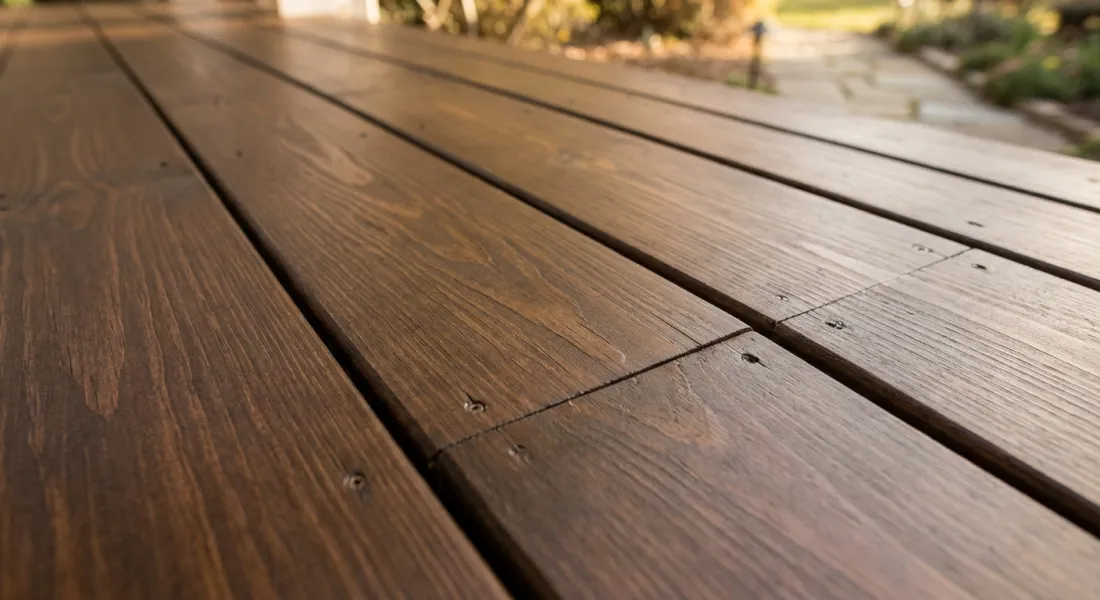
This is the whole ballgame. Stain soaks into the wood and seals it from within, so the wood can still breathe and release moisture. When it wears, it wears thin and even — you just clean and recoat.
Paint forms a film on the surface. On a vertical wall, that film sheds water fine. But on a horizontal deck floor — where rain, snow, and foot traffic work it constantly — moisture gets under the film, and it peels and flakes. Once deck paint starts peeling, the only fix is scraping or stripping it all off before you can recoat. That's why most professionals steer homeowners toward stain on anything you walk on.
Chicago-specific note: Our freeze-thaw winters are brutal on film-forming coatings. Water gets into micro-cracks, freezes, expands, and pops the paint film off. Penetrating stain doesn't have a film to pop — which is why it holds up far better on Chicago back porches.
When Staining Is the Right Choice
- Any surface you walk on — deck floors, stairs, treads, landings
- Chicago back porches — the multi-level wood porches on 2–3 flats
- Wood fences and pergolas — where you want the wood to breathe
- Wood that's still in good shape — stain enhances rather than hides it
- When you want easier future maintenance — recoating stain never requires stripping
When Painting Makes Sense
- Vertical surfaces only — porch ceilings, columns, trim, railings you don't walk on
- Wood that's already been painted — going back to stain would require full stripping first
- When you want a specific opaque color that matches your home's trim exactly
- Badly weathered wood you want fully hidden — though solid stain often does this too
Notice the pattern: paint belongs on the parts of a porch you don't walk on. The floor, stairs, and anything horizontal should be stained.
Cost: Which Is Cheaper Over Time?
Upfront, stain and paint cost roughly the same to apply. The real difference shows up over the years. Because stain never needs stripping — you just clean and recoat — its lifetime cost is lower. Deck paint, once it starts peeling, requires labor-intensive scraping or chemical stripping before every repaint, which adds hundreds of dollars each cycle. For a wood porch you plan to keep, stain is the more economical long-term choice.
For current pricing, see our full guide: How Much Does Deck & Porch Staining Cost in Chicago?
Solid vs. Semi-Transparent Stain
If you go with stain, you have one more decision. Solid stain is opaque — it hides gray, weathered wood and gives that classic rich brown Chicago porch look, and it lasts longest between coats. Semi-transparent stain shows the wood grain and gives a more natural finish, but needs recoating sooner. For older, weathered back porches, solid is usually the right call; for newer decks where the wood still looks good, semi-transparent keeps that natural character.
At RenewBuild, we stain Chicago decks and back porches with Sherwin-Williams SuperDeck, matched to the right solid or semi-transparent finish for your wood. We check the wood's moisture, prep the full porch — floors, stairs, and railings — and back it with a 30-day labor warranty.
Common Mistakes to Avoid
- Painting a deck floor — the #1 regret; it will peel under traffic
- Staining over failing paint — stain can't penetrate through a paint film; the old paint must come off first
- Coating damp wood — neither stain nor paint bonds to wet wood
- Skipping the cleaning/prep — the finish only lasts as long as the prep beneath it
- Using wall paint on a deck — deck surfaces need coatings formulated for horizontal, high-traffic wood
Get Straight Advice for Your Porch
We'll walk your deck or back porch, tell you honestly whether stain or paint is right, and give you a clear, itemized estimate — floors, stairs, and railings included.
Related Articles
RenewBuild Serves Chicago & North Shore
Looking for a painter near you? We serve homes and businesses across Chicagoland.